One thing I tell visitors who ask whether they need a rental car for a few days on the southern shore: probably not. But you have to understand that the shore is split between two regions and two transport companies, with the lake itself as the seam. Brescia is one network. Verona is another. A lake ferry crosses the seam. Once you understand that, the rest is just timetables.
What follows is what I wish someone had handed me my first winter back from Milano, when a simple Friday errand from Padenghe to Bardolino without a car ended in two kilometres of provincial road in the dark.
Two regions, two bus networks
Southern Lake Garda crosses an administrative line nobody marks on the map. Sirmione, Desenzano, Padenghe and Salò belong to Brescia and Lombardy. Peschiera, Lazise, Bardolino, Garda town and Torri del Benaco belong to Verona and Veneto. Buses on the two sides have different liveries, different ticketing, different timetables. No combined ticket covers both shores by road.
What ignores this division is the lake ferry — a single state-run company crossing the water between regions. If you're moving west to east, the ferry is often more practical than going overland through Peschiera.
Western shore: Arriva Italia and the LN026
For most visitors, the bus that ties the western shore together is line LN026, run by Arriva Italia — the company used to be called SIA, and locals still use that name. LN026 starts at Desenzano del Garda railway station, runs along the lakeshore through Rivoltella and Colombare, and terminates at Piazzale Montebaldo, just outside Sirmione's drawbridge.
Summer timetables run every twenty minutes during the day. In winter that drops to every forty. Last bus from Desenzano leaves around 22:30 — slightly later in July and August. A single ticket costs about three euros and is bought at the machine in front of Desenzano station, or at any tabaccheria, or from the driver with a small surcharge.
Arriva also runs longer routes from Desenzano up the western shore — Salò, Gardone Riviera, Toscolano-Maderno — but those are less frequent and most visitors don't need them.
That's the western shore in five paragraphs.
Where to buy bus tickets
Reliable order, in order of preference: the ticket machine at Desenzano station; any tabaccheria (any shop with a black T sign); the small newsagent at Piazzale Montebaldo in Sirmione; the driver, with a euro surcharge and only if you have small change. The vending machine at Sirmione's bus stop has been broken for at least the last two summers.
Eastern shore: ATV from Verona
If you're staying anywhere on the eastern side — Lazise, Bardolino, Garda town, Torri del Benaco — your bus is run by ATV Verona. ATV's network radiates out from Verona Porta Nuova rather than from a lake town, which is what confuses first-time visitors. You generally connect through Verona.
Lines that matter: 162 and 163 from Verona to Lazise and Bardolino; 164 onward to Garda; 484 along the upper eastern shore. They run roughly hourly, less often on Sundays and in winter. Tickets at Porta Nuova, at any ATV office, online via the ATV app, or at tabaccherie. A single fare runs four to six euros.
If you're on the western shore and want to reach Bardolino without going through Verona, the practical answer is the ferry. I once tried the overland version — Sirmione to Peschiera, then Peschiera to Bardolino — and it took two and a half hours where the ferry would have done it in forty minutes.
The lake ferry
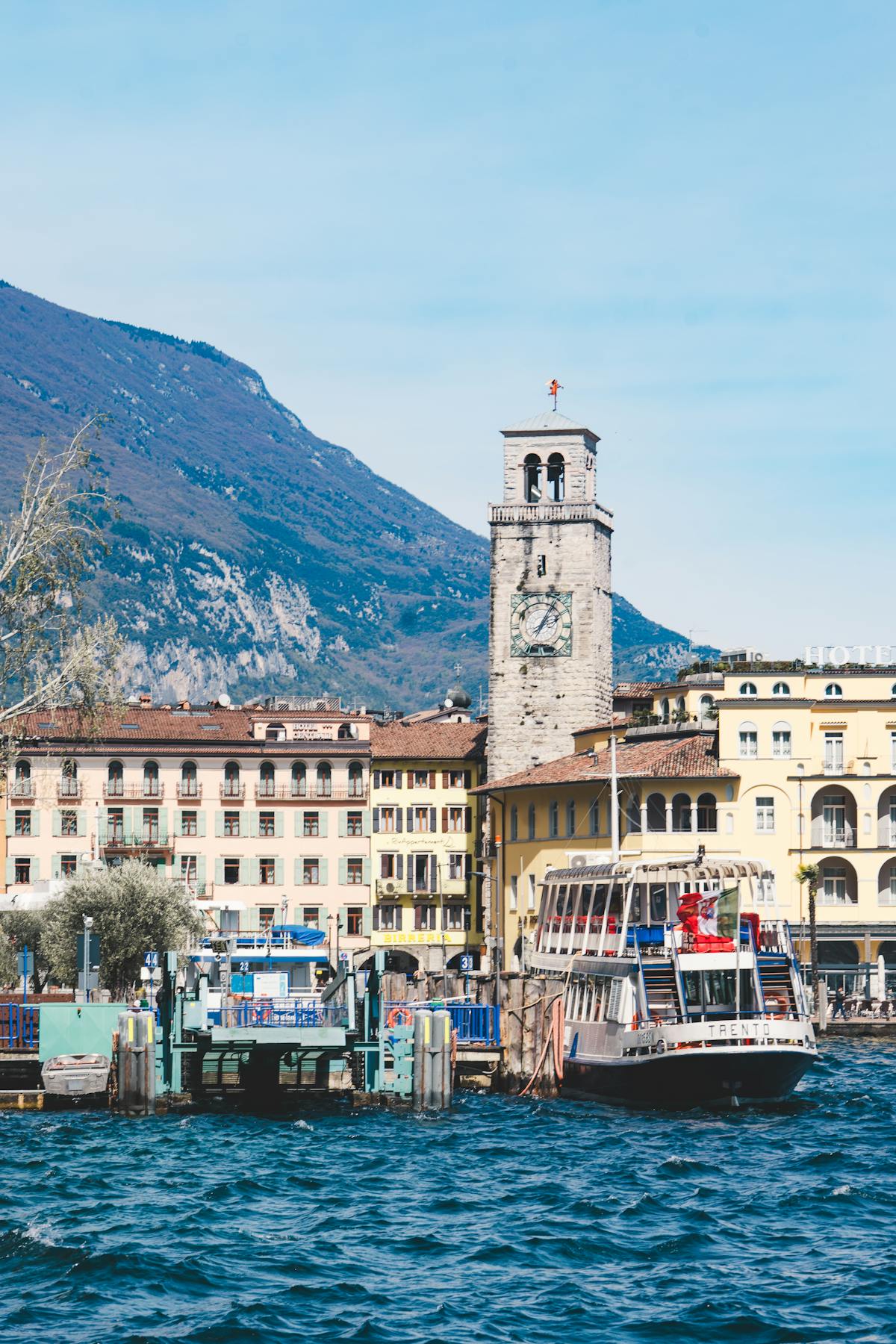
Operating the lake ferry is Navigazione Lago di Garda, a state-run service. On the southern half of the lake, regular routes connect Desenzano, Sirmione, Peschiera, Lazise, Bardolino and Garda town, with longer boats continuing up to Limone and Riva.
Tickets are zone-based. A single ride between two southern stops runs four to twelve euros. Day pass for the southern zone costs around fifteen euros; a full-lake pass is roughly twenty-five.
Full timetable runs from late March through October. In winter the service shrinks — usually only Desenzano to Sirmione on weekends, with gaps. Between November and March, treat the ferry as not running unless you've checked the current schedule three days before.
Where to buy tickets
For ferries, a ticket office sits right at each landing — Desenzano's is on the lakeside promenade two minutes from the railway station; Sirmione's is at Piazzale Porto inside the old town walls. A printed ticket from the kiosk works on every boat and never has connection problems.
For Arriva buses, my rule of thumb is: machine at the station, tabaccheria everywhere else, driver only as a last resort. ATV tickets work the same way, with the addition that ATV's app is usable and has English. Arriva's app exists but I have never made it accept a foreign card.
Taxis and tourist passes
Sirmione has a small licensed taxi cooperative, Cooperativa Taxi Sirmione, with a rank near Piazzale Porto. Taxis are metered and reliable, but they are not New York taxis: you almost never find one cruising for a fare. Call ahead, or ask the hotel to call. Same applies in Desenzano and on the eastern shore.
Various tourist passes — Garda Card, Lake Garda Card, regional cards bundling buses and museums — are usually not worth it. They make sense if you're entering four or five paid museums in a visit. For most southern-shore travellers who want to bathe, eat, and ride one ferry, individual tickets work out cheaper. Do the arithmetic before you buy a card.
A side-by-side comparison
Numbers are typical 2025 fares, off-peak weekday timing.
| Option | Where it runs | Frequency | Cost | Best for |
|---|---|---|---|---|
| Bus LN026 (Arriva) | Desenzano ↔ Sirmione | Every 20 min summer / 40 min winter | €3 | Quick, predictable shore-side hops |
| ATV Verona buses | Verona ↔ eastern shore towns | Roughly hourly | €4–6 | Lazise, Bardolino, Garda town from Verona |
| Ferry (Navigazione) | Western to eastern shore | Multiple daily April–Oct | €4–12 single, ~€15 south day-pass | Crossing the lake without a car |
| Taxi (call-ahead) | Door to door | On request | Metered, varies | Late evenings, luggage, missed buses |
Schedules: what they don't tell you
My biggest practical advice about southern Garda transit is to mistrust the online schedules — not because they're wrong, exactly, but because they go out of date in awkward ways. Arriva publishes seasonal changes on its website and then adds a note about a strike or a roadworks diversion that's only on the printed timetable at the station.
I now do this: on the first day of any visit, I take a photograph of the printed timetable at the station for whatever line I expect to use. Printed versions are what the bus actually follows.
If you've just landed, my companion entry on getting from Verona airport to Sirmione covers the longer leg from the runway to the lake. Once you're here, what time of year is worth the trip is its own conversation, covered in the month-by-month read. For long-distance trains into the region, Trenitalia remains the simplest national network to navigate.