Sirmione's thermal water doesn't come from a tap. It comes from a fissure in the limestone bed of Lake Garda, about three hundred metres east of the Catullus Grottoes and roughly eighteen metres down. Hot water rises out of that opening at sixty-nine degrees Celsius — sometimes a little higher in winter, when the surrounding lake is at its coldest — and meets the cold water of the lake in a turbulent column that cools rapidly as it climbs. By the time the water reaches the surface it's only a few degrees warmer than the lake itself, and you'd never know it was there unless someone showed you. I went out one January morning to be shown.
What the Boiola actually is
"Boiola" is a local Brescian dialect word for a roiling or boiling place — a fitting name for a spring that, in still conditions, can produce a faint shimmer at the lake's surface like the air over a road in summer. Geologists describe the source as a karst spring: rainwater that fell on the southern Alps decades ago, percolated down through limestone, was warmed by the earth at depth, and forced back up through a fracture under the lakebed. The water has been moving underground for somewhere between thirty and a hundred years before it surfaces here, depending on which study you read.
Modern Sirmione discovered (or rediscovered) the spring in 1889. Stefano Spreafico, a Milanese industrialist, had been reading old Roman descriptions of medicinal hot waters at "Sermione," and arranged an underwater survey of the area off the peninsula. His engineer dropped a weighted thermometer at various points until one came back at sixty-eight degrees. By the early 1900s a pipe ran from the spring to a small thermal facility on the headland, and the lineage that became Hotel Terme di Sirmione had begun.
The dawn trip
Riccardo, the fisherman who took me out, has worked the southern basin for forty years. He keeps his boat at the small harbour on Via Piana, and he agreed to row me out in early January for forty euros and a thermos of coffee. We left just after seven, with the sky beginning to lighten over Punta Grò and the air at three degrees. Lake water steamed faintly along the shadowed shore. There were no other boats moving.
It took about ten minutes to reach the patch of water Riccardo wanted to show me. He cut the small outboard, let the boat drift, and pointed at a place that looked exactly like every other place on the lake — flat dark grey water, no obvious feature. Then he asked me to put my hand in.
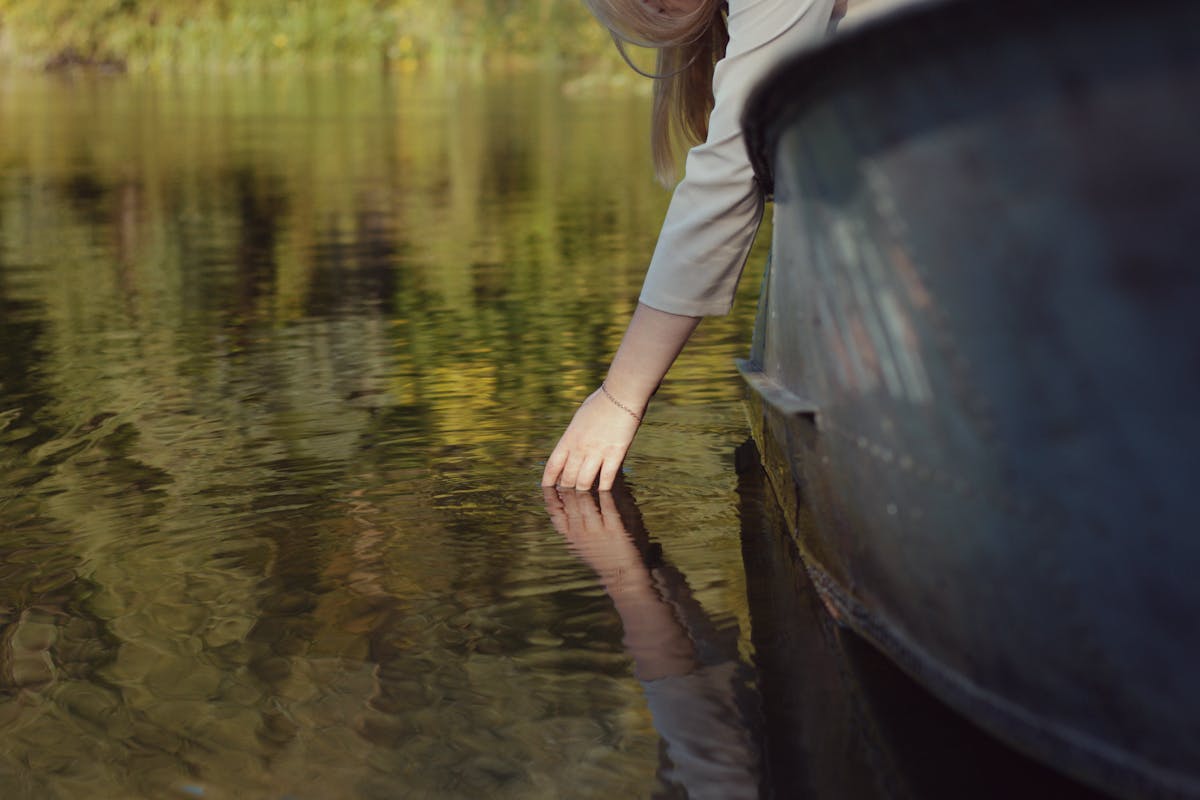
The lake at that point was perhaps four degrees. I lowered my arm over the gunwale and let my fingers trail. Cold. Cold. Then, as the boat drifted another metre, my fingertips passed through a patch of water that was — unmistakably — warm. Not warm like a bath; warm like the air on a mild evening, the difference you'd notice without thinking. It lasted a few seconds, then was cold again. The boat had drifted off the column.
Riccardo grinned. He has done this for twenty years for visiting journalists and the occasional curious local, he said, and the moment of recognition is always the same — a slow grin, a slight laugh, an immediate request to do it again. We drifted back across, and I felt the warmth a second time.
What's in the water
Sirmione's thermal water is classed as sulfurea-salsobromoiodica — sulphurous, saline, bromine-and-iodine-bearing. Mineral content is what makes it medically useful (and gives it that faint, slightly eggy smell you notice at Aquaria's pool deck). A typical analysis from the public health authorities looks roughly like this:
- Hydrogen sulphide — the source of the spring's distinctive smell; mildly antibacterial, useful for inflamed mucous membranes.
- Bromine — historically associated with skin conditions and used in hydrotherapy treatments.
- Iodine — present in unusually high concentrations for an inland spring; one reason the Italian state recognises it for respiratory therapy.
- Sodium chloride — gives the water its slightly saline taste; raises the buoyancy noticeably.
- Magnesium and calcium — present in modest amounts; partly responsible for the soft, slightly silken feel of the water on skin.
None of this is exotic. Other Italian thermal towns have similar mineral profiles. What makes the Boiola unusual is the temperature at depth and the fact that the source is underwater rather than on land — a configuration that's apparently rare in Europe and has made the spring a small case study in geology textbooks.
Arranging your own boat ride
Riccardo isn't on the internet. Neither, as far as I can tell, are most of the dozen or so fishermen who keep boats in Sirmione's harbour. To arrange a trip you walk down to Via Piana early — anytime between six and eight in the morning works — and ask. Italian helps a great deal here, but a written note in Italian also works ("una passeggiata in barca al Boiola, una mezz'ora, quanto costa?" gets the right answer).
Practical detail
Reasonable rates run thirty to forty euros for a half-hour out and back, paid in cash on the boat. Best months are October to early April, when the lake is at its coldest and the temperature contrast is most obvious — a hand in the water can register the column. From May onward the lake warms and the difference becomes harder to feel. Avoid Saturdays in summer, when the harbour is busy with tourist excursions. Bring a thermos.
If you want a more reliable booking, the small operators advertised at visitsirmione.com include a few who do guided sunrise tours that pass over the spring; the experience is more polished and slightly less private. Italy Magazine has run a longer feature on the Boiola in past years that's worth a read for context.
Why none of this is well known
You can spend a week on Sirmione and never realise the spring exists. Aquaria, the centre, doesn't make a tourist feature of it — there's a single panel on the wall that mentions the source, in small print and only in Italian. The peninsula's official tourism office has a brief geological note buried inside its longer historical brochure. Most foreign visitors leave town having had a perfectly nice afternoon in a thermal pool without ever connecting it to the lake outside the window.
That suits me, and Riccardo, and the other fishermen who row the occasional curious soul out to feel the warm patch with a hand over the side. It's a small private joy at the edge of an otherwise crowded peninsula. Next time you book Aquaria, take an hour the morning before, walk down to the harbour with a thermos, and see if you can find someone willing to take you out. The lake is at its quietest then, and the spring is exactly where it has always been.
For the longer historical arc of how the Romans, Catullus, and the nineteenth-century industrialists fit together with the spring, see the history piece. For practical use of the water once it reaches the pools, the Aquaria-versus-Catullo guide is the place to start.